
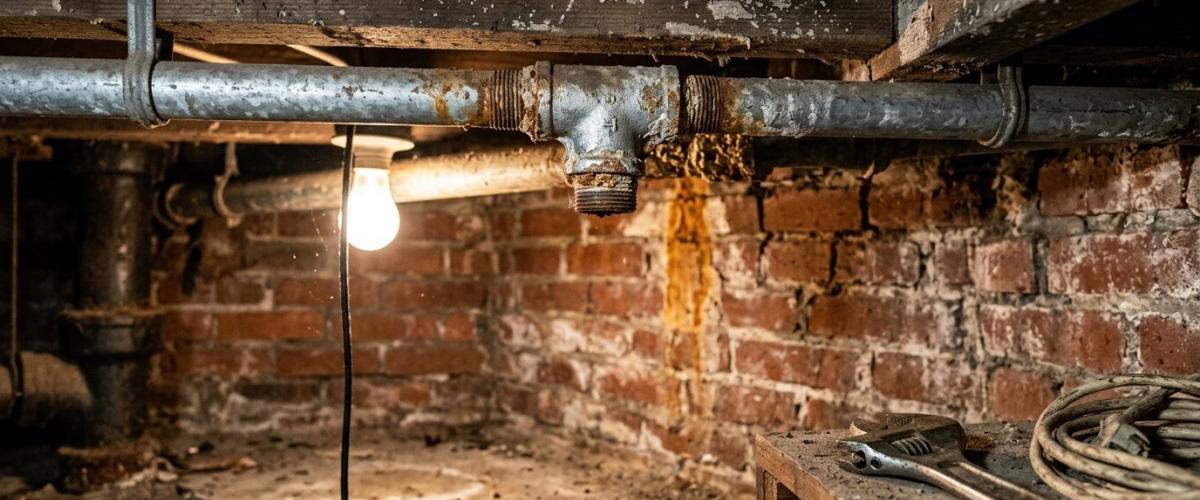

When WJ McNabb Plumbing, a trusted plumber in Pittsburgh, gets a service call from one of the older neighborhoods, the diagnosis usually starts before anyone touches a wrench. It starts with a flashlight in the basement, looking at what's actually in the walls.
Galvanized supply line rusting from the inside. Cast-iron drain stacks corroding at the floor joint. Polybutylene fittings nobody ever flagged.
What follows is the pattern those calls usually take.
What the basement reveals about the house
Most older Pittsburgh homes get their first real plumbing inspection long after the deal closes. The pre-purchase walk-through was scope-limited and visual. The buyer saw working faucets, flushing toilets, and a water heater that looked unremarkable, and the inspection report said the same. None of that touched the actual condition of the supply lines, the drain stacks, or the laterals running out to the city sewer.
The basement is where the truth lives. A flashlight, a quick scan of the water heater, and a walk along the joists tells a homeowner more about the plumbing than the inspection report ever did. The materials and their condition are visible if you know what you're looking at.
Galvanized steel and the rust-from-within problem
Silver-gray pipe with threaded fittings is galvanized steel. Pittsburgh's housing stock contains more galvanized supply line in active service than almost any city its size, because so much of the city was built before copper became the standard residential supply, and a lot of those original installs never got replaced. The pipe looks fine from the outside.
The interior is the issue. Galvanized rusts from the inside, and the rust scale builds up against the inner wall over decades. By the time water pressure drops noticeably at the upstairs fixtures, the pipe wall in the worst spots is already paper-thin and the interior diameter has shrunk by half or more. The failure mode is a pinhole leak that shows up in a wall cavity, runs for weeks before anyone notices, and produces a much bigger repair bill than the original repipe would have cost.
A galvanized supply system is on a clock. A homeowner who knows they have it can plan a phased repipe before the leaks start. A homeowner who doesn't know they have it usually finds out when a kitchen ceiling stains.
Copper, polybutylene, and what the upgrade history looks like
Copper supply line is the upgrade material in most pre-war Pittsburgh repipes. Brownish-orange pipe with soldered joints, holding up well in the local water for decades. The exception is post-1980 thin-wall Type M copper installed in homes that have aggressive water chemistry, where pinhole leaks can show up after a few decades of service. Most Pittsburgh copper is fine.
Polybutylene is the surprise. Some homes built or remodeled in the late 1970s through early 1990s ended up with polybutylene supply line, the gray plastic with brass crimp rings. The pipe itself isn't the problem. The fittings are. They develop micro-cracks over time and fail without warning, often during normal household water pressure cycles. Insurance carriers have started excluding water damage claims tied to polybutylene failures, which converts the repipe from a "should we" question into a "when can we" question.
Modern PEX, identifiable by red and blue flexible plastic with crimp rings or push-fit connectors, is the current standard. A house with PEX throughout is a house where the previous owner already solved this category.
Why Pittsburgh's drain systems age the way they do
The drain stack is the second-oldest piece of plumbing in most older Pittsburgh homes, and the failure pattern is specific to the city's basement environment.
Cast iron's slow exterior rust
A black cast-iron drain stack with hub-and-spigot joints is the original installation in most pre-1960 Pittsburgh homes. Cast iron is heavy, durable, and remarkably long-lived. Some city homes still have functional cast iron pushing 100 years of service.
The vulnerability is at the bottom of the stack, where it transitions to the building drain that runs out under the basement floor toward the sewer. That section sits in a perpetually damp environment for decades and rusts from the outside in. Pinholes develop. The hub at the bottom can crack. The repair is significant work because access requires breaking concrete to get at the pipe under the floor.
Homeowners who notice efflorescence (those white crystalline deposits) around the base of the stack, or a slight depression in the concrete near it, are looking at evidence of slow leakage that has been going on for years. The stack hasn't failed yet, but the trajectory is set.
Tree roots and the lateral line problem
Pittsburgh's older neighborhoods have mature tree canopies with deep, established root systems. Those roots find their way into the clay tile lateral lines that connect basement drains and the main building sewer to the street main. Once a root system establishes itself in a lateral, the cycle repeats: a rooter clears it, the roots regrow, the drain backs up again, usually within 18 to 36 months.
The diagnostic is simple. A floor drain that backs up after a heavy rain, a basement that gets water during storms when it didn't used to, or a main line that backs up under high-volume use are all signs of root intrusion in the lateral. A camera inspection costs $250 to $500 and produces a definitive answer about what's happening underground.
The repair options range from cabling and chemical root treatments to lateral replacement, and the right answer depends on how badly the line has been compromised. The wrong answer is doing nothing, because root intrusion almost always gets worse and the repair cost climbs the longer it's deferred.
The shut-offs, water heaters, and supply lines nobody checks
Three categories of equipment in older Pittsburgh homes are worth examining before they become emergencies. None of them are exotic. All of them get ignored.
The seized main shut-off valve
The main water shut-off where the city service enters the basement is the single most important valve in the house. Most homeowners haven't operated it in years, sometimes a decade or more. Old gate valves on pre-1970 installs commonly seize after long disuse. The handle either won't move or feels loose because the stem has corroded through, and forcing it can snap the handle off in your hand.
A homeowner who tries to use a frozen main shut-off during an active flood discovers they have no way to stop the water, which is exactly when they need it to work. The fix in advance is a quarter-turn ball valve replacement, roughly $225 to $325 on an accessible main. The fix during an emergency costs more, takes longer, and the cleanup bill is on top of the plumbing bill.
This is the cheapest insurance available in any older Pittsburgh basement. The test is trivially quick, and the replacement is straightforward when scheduled in advance.
The water heater that's outliving its odds
Tank water heaters in Pittsburgh's water supply usually last 10 to 15 years before some component forces replacement. Older units develop sediment buildup at the bottom, the heating elements or burner assembly fail, the relief valve corrodes, or the tank itself starts leaking slowly along a seam.
The age is on the manufacturer's label on the side of the unit. A homeowner who knows the unit is past 12 years old can plan the replacement. A homeowner who doesn't know often gets the replacement scheduled for them by a basement flood.
The relief valve and discharge pipe on a tank water heater are worth a separate look. If the discharge pipe is missing, dripping, or visibly corroded, the safety mechanism has been compromised. That's a safety issue, not a maintenance one, and it needs attention before the next bath cycle pushes the system into stress.
Old fixture supply lines and the bulk-replacement opportunity
The small flexible supply lines that connect sinks and toilets to the wall are the fixtures most homeowners never think about. Modern braided stainless steel hoses are fine. Older chrome-tube supplies, bent copper that ran into compression fittings, are showing up as failure points across the city's older homes. Older flexible plastic supply lines from 1980s and 1990s installs have a known failure pattern where the line splits suddenly and produces a high-pressure leak instead of a slow drip.
A homeowner who has eight or ten old supply lines in the house can replace them all at once for under $200 in parts on a single project session. A plumber will charge $150 to $250 per line in labor if the customer has them swapped one at a time on individual service calls. The cost-per-line falls dramatically with bulk handling, and the failure-prevention math improves at the same time.
Frozen-pipe risks specific to Pittsburgh
Pittsburgh sees regular hard freezes, and the housing stock has features that make freeze damage more common here than in milder climates further south.
Hose bibs and the freeze-split pattern
Outdoor hose bibs on older Pittsburgh homes are the most common freeze-failure point. A standard exterior valve has water sitting inside the brass body whenever the line is pressurized. Freezing temperatures expand that water and can split the brass. The leak shows up the next time the bib is turned on, often well after the original freeze, by which point the water has been quietly running into the wall behind the bib for an unknown stretch.
Frost-free hose bibs solve this by locating the actual valve mechanism inside the basement wall, where it stays above freezing. Replacement on a standard bib is $225 to $325. A frost-free upgrade is $275 to $425. The cost difference is small relative to the freeze damage a split bib can cause inside a wall cavity.
Any older Pittsburgh home that hasn't had its hose bibs upgraded is on the list of "schedule before failure, not after."
Exposed pipe runs in cold-side walls
Some pre-1950 Pittsburgh homes have supply line runs in exterior walls that are minimally insulated. During a cold-side freeze, those runs can ice up and split, and the failure mode is the same as a hose bib: the leak shows up when the line thaws and water starts flowing again, sometimes inside finished space.
The diagnostic is to identify which walls in the house contain supply runs and whether those walls are exterior. A plumber walking the house can usually map this out in one visit. The fix ranges from adding pipe insulation to rerouting the line through interior framing, depending on the situation.
Why Pittsburgh's housing stock keeps surprising people
The patterns above repeat across the city not because Pittsburgh plumbers do their work poorly, but because the city's housing inventory is unusually old, unusually layered, and unusually constrained.
Layers of partial repipes
A typical pre-1960 Pittsburgh home has had multiple owners across its lifespan, each of whom did partial repipes and partial drain replacements as failures forced the work. The result is a house with galvanized in one section, copper in another, and PEX in a third. Plumbers diagnosing problems in mixed-material homes have to figure out which section is causing the issue, and that takes longer than a single-material house.
The mixed-material reality also affects pricing. A repair that needs new fittings has to match whatever material is at the connection point, and transitioning between materials adds parts and labor that wouldn't apply on a uniform system.
Hillside basements and access realities
Pittsburgh's terrain produces basements that flat-lot suburbs don't have. Homes on slopes have basements that step down into the hillside, with limited access to the rear sections of the plumbing. Some homes have crawlspaces under the rear of the house that are hard to enter and harder to work in.
Repairs that would be straightforward in a single-level basement on flat ground get more expensive in a hillside Pittsburgh basement because the labor takes longer. A plumber who quotes a job by phone without seeing the access conditions usually quotes it low and adjusts upward when they arrive.
Brittleness in old fittings
Cast iron, galvanized, and old fittings get brittle over decades of service. A plumber working on an old fitting often finds that the act of unscrewing the connection cracks the part being unscrewed. That turns a $200 repair into a $500 repair because there's now an unexpected piece that needs replacement.
This is the cost of working with materials that have been in service longer than most modern construction lasts in total. Bad workmanship doesn't enter into it.
How to use what's in the basement
A homeowner who has done the basement walk-through ends up with a list. Some items are urgent (a seized main shut-off, a leaking water heater, an active polybutylene system). Some items are aging (galvanized supply, an old cast-iron stack, original hose bibs). Some items are clean (modern PEX, recent copper, frost-free bibs, a PVC drain stack).
Calling a plumber with specific findings
A plumber who walks into a basement and is told "the main shut-off is seized, the cast-iron stack has staining around the base, and the water heater is from before the previous owner" diagnoses faster and bills less than a plumber who walks into a basement with a vague "something feels off" framing. The pre-call diagnostic by the homeowner accelerates the work.
Photos of each finding, taken during the walk-through, help even more. A plumber who can see the actual condition of the materials before rolling the truck loads the right parts and the right tools, which saves a return trip back to the supply house.
Sequencing repairs instead of reacting to them
The list lets a homeowner sequence repairs. The urgent items get scheduled first. The aging items get phased over a planned timeline that fits the household's budget. The clean items don't need attention.
Most homeowners default to handling plumbing in emergency mode, and emergency-mode pricing is always higher than planned-repair pricing. The shift from reactive to scheduled repairs usually saves more in a single year than the cost of the diagnostic walk-through that produces the list.
What the older neighborhoods teach the rest of the city
The plumbing patterns in pre-1960 Pittsburgh homes function as a preview of what other older housing stock around the country will look like as more homes age into the same maintenance window. Each older neighborhood gets there eventually.
The lesson the city's older neighborhoods offer is that plumbing aging is predictable, manageable, and almost always cheaper to handle on a planned schedule than as a series of emergencies. The houses that age well are the ones whose owners know what's in the basement and treat it as a regular check-in instead of an emergency-only zone.
The plumbing isn't going to age in reverse. Every cycle of household use adds a little more wear to the materials, the joints, and the fittings that have been in service since the original install. Homeowners who walk the basement with a flashlight, who know the ages and materials of the major systems, and who call a plumber with specific findings instead of vague concerns end up paying less for the same outcomes. That's the older-Pittsburgh-home plumbing lesson, condensed.
